

Misaligned Authority is Causing You Burnout
A number of years ago as a project manager, I was asked by a VP to set-up a brand-new, fully functioning Salesforce instance over the weekend. The present day version of me can laugh at this for the absurdity that it is, but at the time, I was a ball of stress. It didn’t feel like I had a choice, and I was worried about the security of my job. It’s not that I lacked the technical skills to do so, nor did I lack the motivation and drive. But a Salesforce implementation is usually a project that lasts months or even years depending on the complexity. We didn’t have the proper planning done. I had no additional resources to make this happen. Yet, there sat the request on Friday to have it up and running by Monday.
What I know now, is that this request was not about taking over my weekend. It was another organizational pattern where leadership decisions were made and passed down the hierarchy to let other people absorb the consequences. Now, this is an extreme example that shows some of the impossibility of such requests. These types of requests of responsibility expect sacrifice, but pay no attention to authority.
Let’s dig into this a little more. The Salesforce request was another item in a long list of responsibilities given to me at the time. I was regularly working evenings and weekends to cover the responsibilities that were assigned to me. I didn’t want to pass it onto my team, and according to my superiors, these things needed to be done. The strategy continued to change, and each new week incurred new high priority projects while maintaining that the others were also of highest importance.
Misdiagnosed Burnout
When I was in the role single-handedly setting up Salesforce and worrying about all sorts of other things that came my way, I blamed myself. You see, the organization followed the advice of too many leadership tropes that what I needed was: better prioritization, better time management, better self-care, and more resilience.
The problem with this advice is that it doesn’t address the underlying issue. It assumes that the problem is volume. The reality is that volume is a symptom of a deeper issue that leaders are often asked to carry responsibility they cannot meaningfully control. Being asked to set-up Salesforce was not the problem. The problem was that I was not allocated any resources – time, budget, and team members to accomplish my new responsibility.
The Authority Gap
Leadership becomes unsustainable when there is an authority gap: the gap between what you’re accountable for and what you’re empowered to influence. Sometimes that gap is authority. Sometimes the gap is resources. The larger the gap, the more energy leaders expend trying to bridge it.
This could look like:
- Being responsible for results but not for staffing. Maybe you’ve been told that you need to see an increase in sales so your marketing team is asked to expand what they’re doing, but you haven’t been granted more staff. Or, the expectation is that clients need more high-touch customer service to be retained, but you can’t hire more customer service staff.
- Being responsible for culture, but not for performance management. You’re told that you need to manage other people and get them to move forward, but they don’t report to you, and frankly couldn’t care less about what you think. Maybe you bring your boss a challenge and they ask you to direct someone that reports to them instead of taking care of it themselves.
- Being responsible for projects, but not for priorities. The projects keep coming and they now out-number the staff you have. You ask for a list of the things that are most important, and they list each of them. When everything is a priority, nothing is a priority, but you don’t feel like you can say that without being told to just figure it out.
- Being responsible for innovation, but not for funding decisions. How many of us are being told we need to use AI with our teams (even those of us who don’t work on technology teams), but there is no budget and no strategy behind it?
Each of these things has an authority gap – and most leaders fill that gap on their own. This is where over-functioning expands.
Over-Functioning is What Authority Gaps Create
None of us start over-functioning on our own. It’s not a personality trait. It begins out of necessity. When authority is unclear or there is a gap, leaders compensate for it.
This could look like:
- Chasing decisions
- Solving problems for everyone
- Working after hours
- Becoming the escalation path
- Carrying information others should own
- Holding the organization together through effort
Over time, this becomes the new normal. Other people might even praise the over-functioning leader for being dependable and responsible. But this over-functioning is actually subsidizing a broken system.
The Hidden Cost of Heroics
Every organization loves heroic leaders. These heroics move the organization forward while also keeping the dysfunction invisible. The organization sees success because deadlines get met, customers stay happy, projects launch, crises get resolved.
But, it comes at a cost. While the organization is busy celebrating the “success”, they often ignore the exhaustion, resentment, turnover, reduced creativity, and leadership attrition that accompany the over-function.
The frustrating thing for the leaders is that this becomes a new cycle. The system learns that it doesn’t need fixing because someone will always save it.
Sustainable Leadership Requires Alignment
Sustainable leadership is like a three-legged stool. The three legs are: responsibility, authority, and resources. Each of these “legs” need to be even or the stool doesn’t function as it should – the more misaligned they are, the more the stool needs to be propped up by the leader.
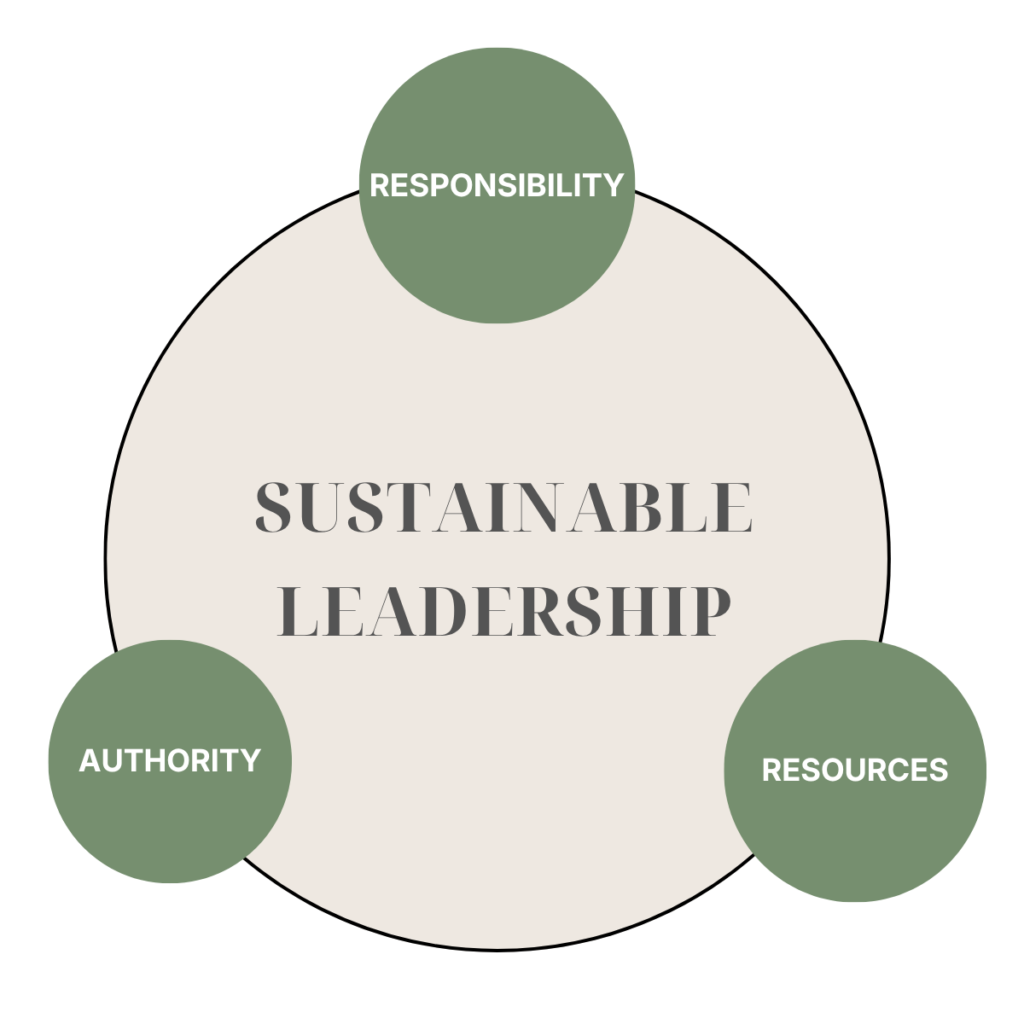
Responsibility is the accountability of outcomes and processes. If you know what you’re being held accountable for, you know what responsibility is yours.
Authority is what power you have. This could be decisions you can make, or orders you can give. This is the ability to wield resources.
Resources are what support mechanisms you have available. This often looks like team members, budget, and time.
If all of these things align, leadership is sustainable. If responsibility grows without authority or resources, the leader often supplements, and burnout becomes predictable. This is not the fault of the leader; it’s because the system is out of balance and the stool is off-kilter.
A Different Burnout Question
When the eventual unsustainability shows up from an unbalanced leadership alignment, most leaders ask: “How do I manage all of this?” But the better question is actually “What am I compensating for by carrying this?”
Going back to the Salesforce example, I had asked myself how I was going to manage implementing Salesforce as soon as possible. Had I given myself the space, I might have recognized that I was being asked to build Salesforce out in a short time to accommodate low sales, poor planning, and a general lack of strategy in how to effectively run the organization. The more that I over-functioned by allowing the responsibility creep without also expanding the authority and resources, the more the system relied on me. It’s not sustainable. I know this first-hand.
It took us months to implement Salesforce. Though I worked most of the weekend, it was far more than a weekend project. I came to them with a project plan on how to successfully implement such a pivotal tool. The organization noticed the push-back and continued to push more responsibility toward me. What nobody noticed was the cost.
If This Feels Familiar…
If you’re carrying outcomes that aren’t fully yours to own, constantly bridging organizational gaps, or feeling exhausted despite doing everything “right,” the problem may not be your workload.
It may be that responsibility, authority, and resources have fallen out of alignment.
The Authority Reset is an eight-week leadership experience designed to help leaders identify authority gaps, stop over-functioning, establish healthier boundaries, and lead with greater clarity and confidence.
If you’d like to be the first to hear when the inaugural cohort opens, join the waitlist.